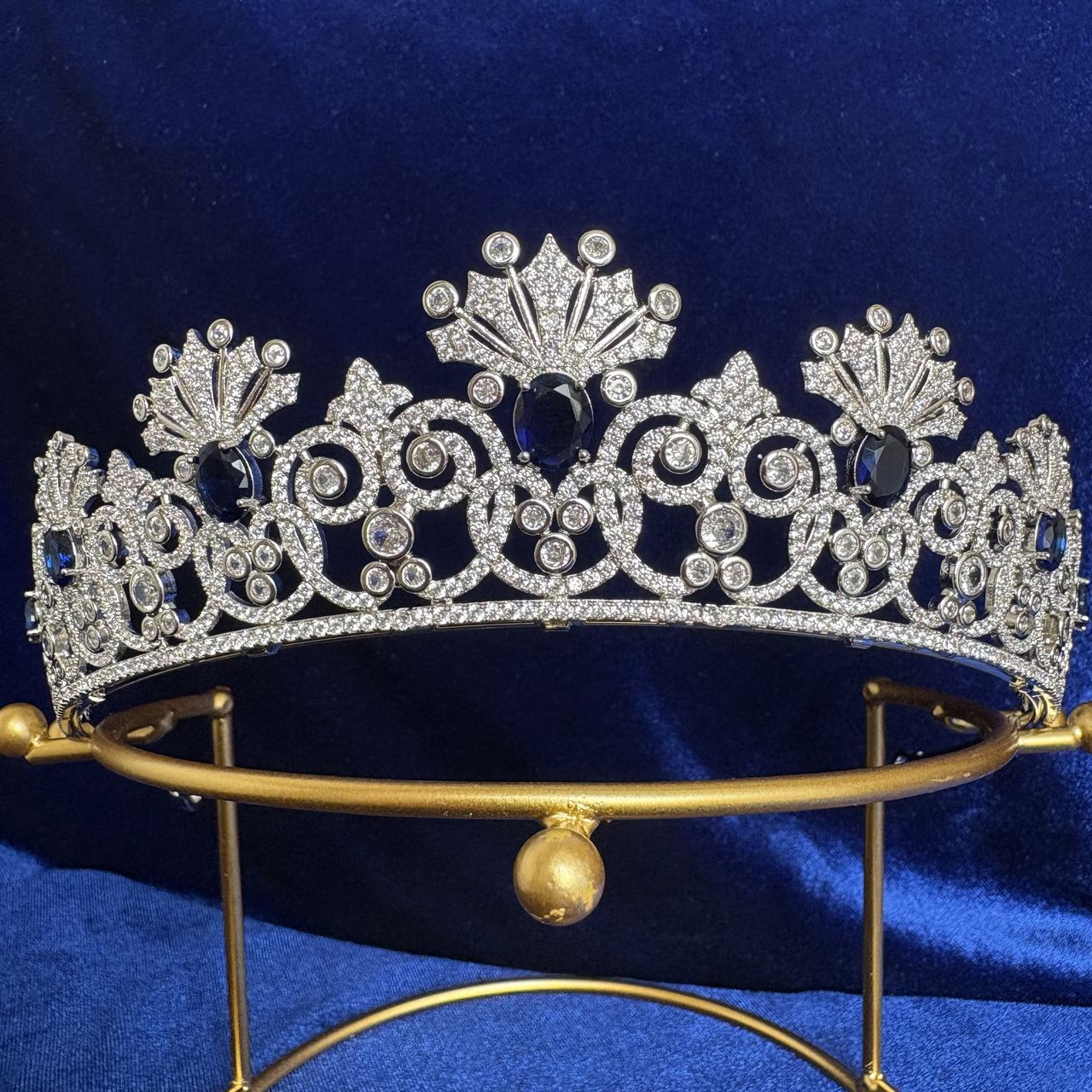
Empress Feodorovna Sapphire Kokoshnik Tiara
- MADE TO ORDER
- Handcrafted with excellent craftsmanship & finest materials
Size & Material
Size & Material
2
Shipping
Shipping
⦁ Ship with UPS (Tracking Code Included)
⦁ Secure Packaging - Double-Walled E-Commerce Box, Bubble Wrap, and Fragile Sticker
⦁ If the package is lost during shipping, I offer a FULL REFUND or a NEW ITEM (your choice) (If the tracking code shows no delivery)
⦁ GLOBAL SHIPPING Available
⦁ Express Shipping Available (Please contact before ordering)
Comes With
Comes With
⦁ U-shaped bobby pins
⦁ Cleaning Cloth
⦁ Thank You Card
⦁ Silica Gel
All Details
All Details
⦁ AAA+ Ultra Reflective, Ultra Clear Diamond-Cut Premium American Diamond (CZ)
⦁ Diamond Like Extremely Shiny Finish
⦁ Crafted to perfection, this piece captures and reflects light flawlessly – whether under natural sunlight or artificial lighting. It photographs beautifully, showcasing its radiant brilliance every time.
⦁ Real Platinum Coating – up to 5–10 times more tarnish-resistant than 925 sterling silver
⦁ Handmade -Excellent Craftsmanship
⦁ Produced with a great respect for your biggest day
⦁ Exactly as Pictured
⦁ Micropavé Technique – Securely set stones that stay in place
⦁ Two Loops on Each End – Easily attach with bobby pins for a secure hold
⦁ Damage-Resistant Flexibility – Made with a special alloy blend that offers ideal strength.
⦁ Veil-Friendly Design – Can be worn with or without a veil
⦁ Hassle-Free Returns – Easy refund and return process

History of The Orijinal Royal Jewel
Read The Story Behind The Sparkle
The Sapphire Bandeau of Empress Maria Feodorovna
The historical record of the Romanov dynasty is characterized by a vast treasury of ornaments, many of which are now accessible only through archival documentation and formal portraiture. Among these lost artifacts is the sapphire bandeau that belonged to Empress Maria Feodorovna. This piece functioned as the centerpiece of a comprehensive parure, which included a matching necklace, earrings, and a brooch, all unified by the use of saturated blue sapphires and brilliant-cut diamonds. The suite is believed to have entered the imperial collection around 1866, coinciding with the marriage of the Danish-born princess to the future Tsar Alexander III, serving as a material representation of the immense wealth of the St. Petersburg court.
Architecturally, the bandeau reflected the aesthetic preferences of the mid-19th century, which prioritized modularity and versatile application. In contrast to the imposing, high-profile kokoshniks that defined later imperial fashion, this ornament was designed with a lower silhouette, suitable for wear across the forehead or integrated into the elaborate hairstyles of the 1870s. The primary focal point of the jewel was a substantial, faceted sapphire noted for its transparency and deep tonality, enclosed within an intricate diamond framework. A definitive visual record of the piece is found in an 1874 portrait by Heinrich von Angeli, where the Empress is depicted wearing the bandeau alongside the insignia of the Order of St. Catherine.
Following the political shifts of 1917, the provenance of the sapphire bandeau diverged from the items the Dowager Empress was able to retain during her departure from Russia. While a small selection of her personal jewels reached the United Kingdom and Denmark, the majority of the state and imperial assets including this sapphire suite remained in Russia under the control of the successor administration. In 1922, the parure was formally documented and photographed as part of a comprehensive inventory of the Diamond Fund, conducted to assess the mineral and historical value of the seized assets.
Despite its status as a masterpiece of imperial craftsmanship, the sapphire bandeau was not preserved as a national treasure. During the late 1920s, the administration designated the parish for deaccession to generate foreign currency. The set appeared in a significant 1927 auction held in London, where it was acquired by private interests. Since that transaction, the bandeau has remained absent from the public record. Historians suggest that the piece was likely dismantled, with the constituent gemstones repurposed for contemporary designs a frequent occurrence for auctioned noble assets during that era. Today, the ornament survives only as a historical record, preserved in specialized catalogs and the imperial portraits of the 19th century.
The Grand Duchess Adelaide Tiara is recognized as one of the most historically significant and enduring diadems within the Grand Ducal collection of Luxembourg. Originating between 1865 and 1870, the piece is a foundational legacy of the House of Nassau. Although historical documentation does not specify a particular artisan, the technical execution, specifically the mounting methods and the integration of mixed-cut diamonds indicates the proficiency of a premier 19th-century German or Austrian jewelry workshop. The ornament is named after Grand Duchess Marie-Adelaide, the first sovereign female ruler of Luxembourg, who reigned from 1912 to 1919. Her frequent utilization of the piece in official state photography established a permanent historical link between the diadem and her sovereign image.
Architecturally, the Grand Duchess Marie Adelaide Tiara serves as a definitive example of 19th-century modularity. It is engineered as a compact, diamond-set diadem featuring a central element designed for versatility. The primary aesthetic consists of graduated diamond arches, often described as leaf motifs, each enclosing a central cushion-cut diamond and topped with pear-shaped diamond finials. A distinguishing technical feature is the central marquise-shaped diamond, situated within an intricate scrollwork frame. This focal point is designed to be interchangeable with a sapphire, permitting the wearer to adapt the headpiece to coordinate with diverse gemstone sets. Throughout the 20th century, the tiara became a traditional choice for the family’s consorts and princesses, favored for its ergonomic scale in comparison to more monumental state crowns.
In the contemporary era, the diadem remains a functional and sentimental asset within the Grand Ducal archives. It is frequently selected by younger members of the dynasty for their initial diplomatic appearances or for high-profile gala events. The piece has been utilized by nearly all prominent women of the current court, including the Hereditary Grand Duchess and Princess Alexandra. Its consistent appearance in modern ceremonies, including several significant nuptials, underscores its role as a symbol of historical continuity for the House of Nassau-Weilburg. The tiara represents a visual bridge between the early 20th-century origins of the Grand Duchy and the contemporary stability of the sovereign house.