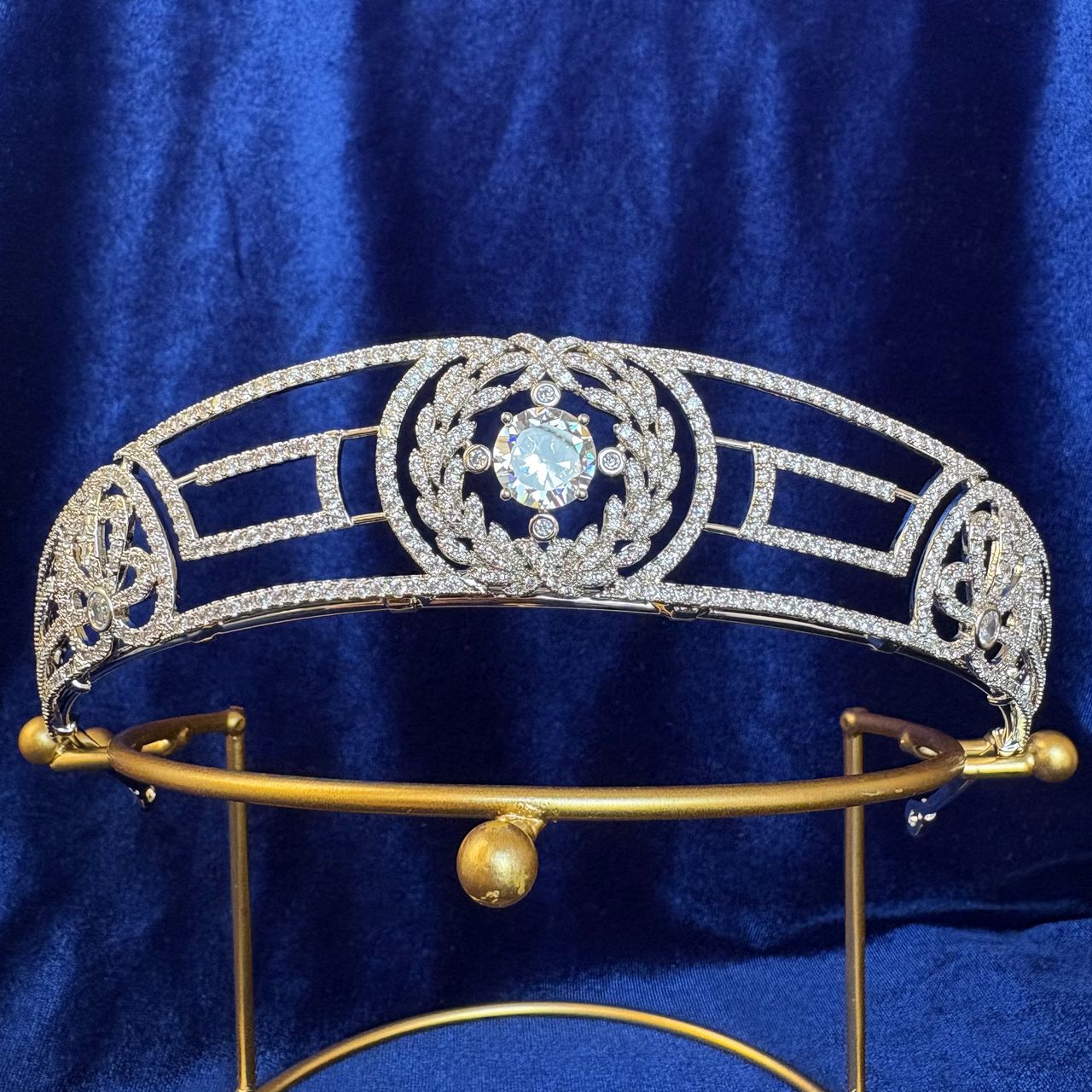
The Prussian Meander Tiara Replica
- MADE TO ORDER
- Handcrafted with excellent craftsmanship & finest materials
Size & Material
Size & Material
1
Shipping
Shipping
⦁ Ship with UPS (Tracking Code Included)
⦁ Secure Packaging - Double-Walled E-Commerce Box, Bubble Wrap, and Fragile Sticker
⦁ If the package is lost during shipping, I offer a FULL REFUND or a NEW ITEM (your choice) (If the tracking code shows no delivery)
⦁ GLOBAL SHIPPING Available
⦁ Express Shipping Available (Please contact before ordering)
Comes With
Comes With
⦁ U-shaped bobby pins
⦁ Cleaning Cloth
⦁ Thank You Card
⦁ Silica Gel
All Details
All Details
⦁ AAA+ Ultra Reflective, Ultra Clear Diamond-Cut Premium American Diamond (CZ)
⦁ Diamond Like Extremely Shiny Finish
⦁ Crafted to perfection, this piece captures and reflects light flawlessly – whether under natural sunlight or artificial lighting. It photographs beautifully, showcasing its radiant brilliance every time.
⦁ Real Platinum Coating – up to 5–10 times more tarnish-resistant than 925 sterling silver
⦁ Handmade -Excellent Craftsmanship
⦁ Produced with a great respect for your biggest day
⦁ Exactly as Pictured
⦁ Micropavé Technique – Securely set stones that stay in place
⦁ Two Loops on Each End – Easily attach with bobby pins for a secure hold
⦁ Damage-Resistant Flexibility – Made with a special alloy blend that offers ideal strength.
⦁ Veil-Friendly Design – Can be worn with or without a veil
⦁ Hassle-Free Returns – Easy refund and return process

History of The Orijinal Royal Jewel
Read The Story Behind The Sparkle
The Prussian Meander Kokoshnik Tiara
The Prussian Meander Tiara stands as a definitive artifact of the German Imperial treasury and a significant survivor of the 20th-century political transitions. Unlike numerous royal assets that were dispersed or liquidated following the 1918 revolution, this imposing diadem remains a primary heirloom of the House of Hohenzollern. Its history originates at the zenith of the empire in 1905, commissioned as a wedding gift for Duchess Cecilie of Mecklenburg-Schwerin upon her marriage to Crown Prince Wilhelm, the eldest son of Kaiser Wilhelm II.
Geometric Innovation and Structure
The architecture of the piece was notably advanced for the Edwardian period, signaling a move toward the streamlined aesthetics of the upcoming decades. Produced by the Frankfurt-based court jewelry house, Koch, the tiara was executed in platinum and diamonds, a combination selected for its structural integrity and superior light return. The design adopts the kokoshnik silhouette, a traditional Russian form characterized by a wall of light that increases in height toward the central axis.
The visual identity of the ornament is defined by a complex geometric lattice. The primary motif is a continuous Greek key (meander), which is seamlessly integrated with stylized floral trefoils and intricate diamond-set webs. This rigid, mathematical symmetry gave the piece a modern, almost proto-Art Deco appearance nearly twenty years before the style became a dominant global movement.
A Dynastic Transition
Crown Princess Cecilie, a significant fashion icon of the German court, utilized the tiara as a signature element of her ceremonial wardrobe. Following the collapse of the monarchy, the Hohenzollerns retained the piece as private property. In 1938, the diadem entered a new historical phase when it was worn by Grand Duchess Kira Kirillovna of Russia, a descendant of the Romanovs upon her marriage to the Crown Prince’s son, Prince Louis Ferdinand. The kokoshnik form was particularly resonant for the Grand Duchess, as it visually reconciled her Russian heritage with her role within the Prussian dynasty.
Contemporary Legacy and Distinction
Within the field of gemology and royal history, it is essential to distinguish this diadem from the smaller Prussian Diamond Tiara currently held by the Spanish Royal Family. While both share Hohenzollern origins and utilize meander motifs, the Prussian Meander Kokoshnik is significantly larger and more architecturally complex.
Today, the ornament remains the principal bridal crown of the Prussian house. Its most recent high-profile appearance occurred in 2011, when it was worn by Princess Sophie of Isenburg for her marriage to Georg Friedrich, Prince of Prussia. As a rare intact survivor of the Imperial German era, the tiara continues to serve as a glittering material record of the House of Hohenzollern’s history and its enduring connection to the aesthetic traditions of the 19th and 20th centuries.