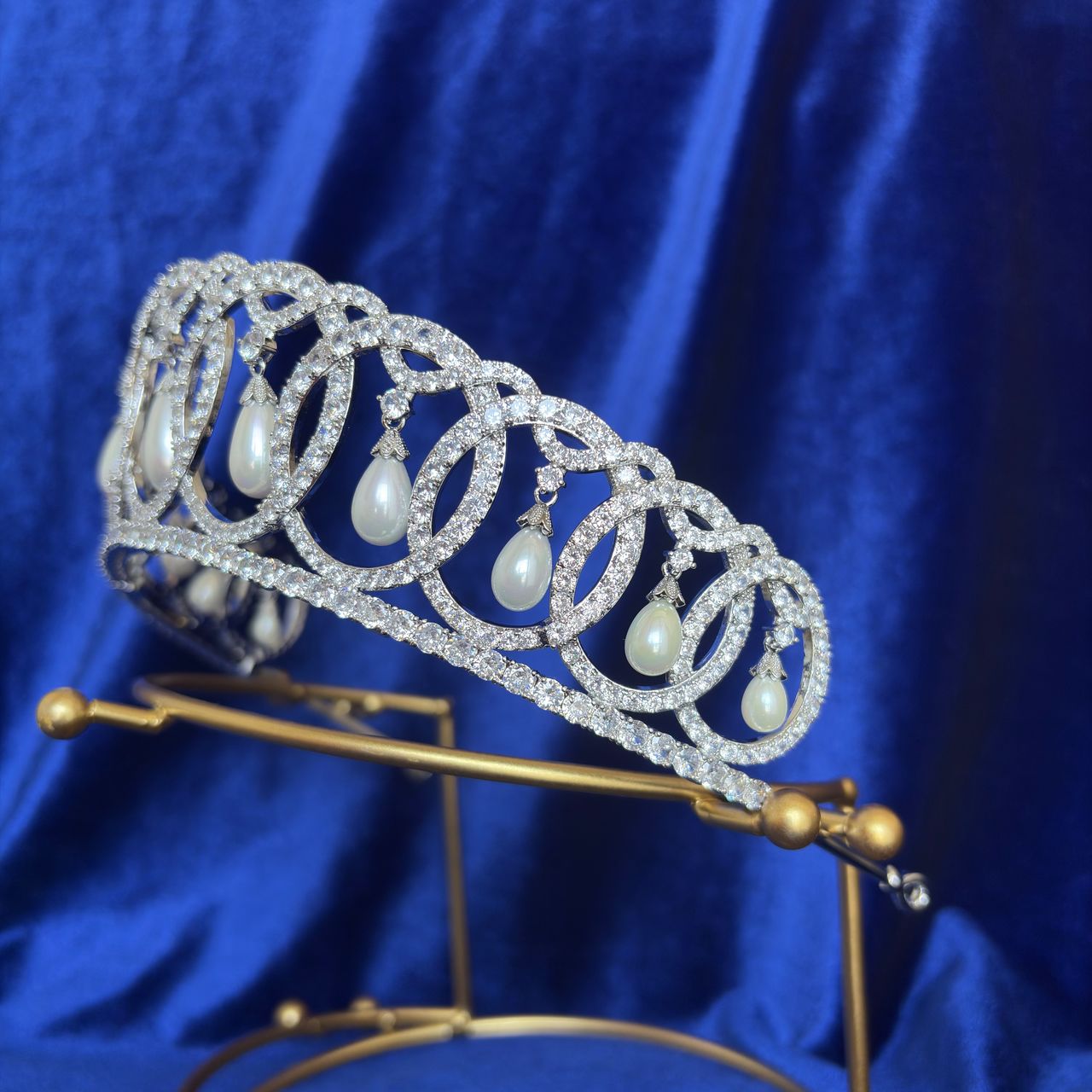
Grand Duchess Vladimir Kokoshnik Tiara

Fine Royal Reproductions

The Vladimir Tiara is a breathtaking masterpiece of survival and engineering, originating from the opulent world of Imperial Russia. Originally commissioned by the formidable Grand Duchess Vladimir, this diadem was famously rescued from St. Petersburg during the Revolution and later became a cornerstone of the British Royal collection. Our high-quality Vladimir Tiara replica captures the intricate beauty of the fifteen interlaced diamond circles that defined the "sovereign’s jewel." Whether viewed as a symbol of Romanov heritage or as a favorite of Queen Elizabeth II, this piece remains one of the most storied Russian grand duchess vladimir tiara designs, offering a timeless halo of brilliance that bridged two great dynasties.

Skip to product information
1 of 8

Grand Duchess Vladimir Kokoshnik Tiara

Fine Royal Reproductions

Grand Duchess Vladimir Kokoshnik Tiara

The Vladimir Tiara is a breathtaking masterpiece of survival and engineering, originating from the opulent world of Imperial Russia. Originally commissioned by the formidable Grand Duchess Vladimir, this diadem was famously rescued from St. Petersburg during the Revolution and later became a cornerstone of the British Royal collection. Our high-quality Vladimir Tiara replica captures the intricate beauty of the fifteen interlaced diamond circles that defined the "sovereign’s jewel." Whether viewed as a symbol of Romanov heritage or as a favorite of Queen Elizabeth II, this piece remains one of the most storied Russian grand duchess vladimir tiara designs, offering a timeless halo of brilliance that bridged two great dynasties.

Regular price $220.00
Regular price Sale price $220.00
Sale Sold out
Shipping calculated at checkout.
Ships within 12-18 days days

Shipping

  • Ships via UPS — tracking number sent to your email upon dispatch
  • Worldwide shipping to all countries and destinations.
  • Complimentary shipping on all orders within the United States
  • Delivery warranty included on every single order
  • 30-day returns on all unworn items from date of delivery
✦   Artisan Made, On Time   ✦

Ready for Your Special Night ?

How many days until your event ?
Uncompromising Craftsmanship

Heirloom Quality

The Standard of Brilliance

  • Tarnish-resistant coating. Restores to its original brilliance with just a jewelry polishing cloth.
  • Crafted with a micropavé setting where every stone is integrated through heat and pressure, ensuring they stay securely in place forever.
  • Guaranteed to match. The physical product is identical to the one featured in the photos and videos.
Curated with the finest elements

Materials

  • Ultra-Reflective Premium AAAAA+ Cubic Zirconia
  • High-Quality Alloy
  • Genuine Platinum Plating
  • Shell Pearls ~ Shell pearls are made from pearl oysters; the inner part of pearl oysters are ground to a fine powder and reshaped, and they are more durable than freshwater pearls.
A Tailored Glimmer

Measurements

  • 8
View full details

Notre Héritage

Royal Timeline

1874
Commissioned for Grand Duchess Maria Pavlovna (the Elder), wife of Grand Duke Vladimir Alexandrovich. The tiara is created in St. Petersburg with fifteen interlaced diamond circles, each suspending a pear-shaped pearl.
1917
During the Russian Revolution, the tiara is left hidden inside a secret vault in the Vladimir Palace as the Grand Duchess flees Russia.
1919
British diplomat Albert Stopford secretly retrieves the tiara and other jewels from the palace and smuggles them out of Russia, delivering them to the Grand Duchess in exile in Europe.
1921
After the Grand Duchess’s death, Queen Mary purchases the tiara for the British Royal Collection. The frame is repaired and adapted to allow interchangeable pendant stones.
1920s
Queen Mary introduces the emerald configuration using the Cambridge emeralds, allowing the tiara to be worn with pearls, emeralds, or without pendants.
1953
Queen Elizabeth II inherits the Vladimir Tiara and begins wearing it regularly at state banquets and major royal occasions.
1980s–2010s
The tiara becomes one of Elizabeth II’s most recognized pieces of evening regalia, appearing frequently with both the pearl and emerald settings.
2022
Following the death of Queen Elizabeth II, the tiara remains within the British royal vaults as part of the Crown’s historic collection.
2023
Queen Camilla wears the emerald configuration of the Vladimir Tiara at a major state function during the reign of King Charles III.

Chosen By

Royal Wearers

Grand Duchess Maria Pavlovna
Queen Mary
Queen Elizabeth II
Queen Camilla

Discover More Treasures

EXPLORE THE FULL COLLECTION

From Past to Present

The Whole Story of The Original Royal Jewel

Vladimir Tiara

The Vladimir Tiara is far more than a decorative ornament; it is an architectural masterpiece and a legendary survivor of the Russian Revolution. Commissioned around 1874 for the Grand Duchess Maria Pavlovna (the Elder), wife of Grand Duke Vladimir Alexandrovich, the diadem was manufactured by a prominent Imperial Court jeweler in St. Petersburg. It was designed to represent the zenith of Romanov splendor, featuring fifteen interlaced diamond circles, each suspending a swinging pear-shaped pearl.

The Daring Rescue

The tiara's journey from the Russian Empire to the British Royal Family is one of the most dramatic stories in jewelry history. In 1917, as the revolution swept through St. Petersburg, the Grand Duchess was forced into hiding, leaving her vast treasury concealed within a secret vault at the Vladimir Palace.

In a covert operation, Albert Stopford, a British diplomat and antiques specialist close to the family, infiltrated the palace. Disguised as a laborer, he retrieved the collection, stowing the Vladimir Tiara and other priceless artifacts into plain Gladstone bags. He successfully smuggled the treasures across the border to London, eventually returning them to the Grand Duchess in her French exile.

Queen Mary’s Innovation

Following the death of the Grand Duchess in 1920, the diadem which had sustained minor structural damage during its journey was purchased by Queen Mary in 1921. Mary, an expert in gemology and jewelry engineering, recognized the piece's potential for modernization. She commissioned a British royal jewelry workshop to repair the frame and introduce a revolutionary modular system.

Queen Mary utilized a collection of magnificent green stones known as the Cambridge Emeralds to create a secondary configuration. This technical innovation allows the tiara to be worn in three distinct states, making it the most versatile diadem in the royal vaults:

  • The Pearl Setting: Featuring the original fifteen swinging natural pearls.
  • The Emerald Setting: Replacing the pearls with fifteen pear-shaped cabochon emeralds.
  • The "Widowed" State: Worn as a "clean" frame of interlaced diamond loops without any pendant stones, emphasizing its geometric brilliance.

A Sovereign’s Signature

Upon inheriting the diadem in 1953, Queen Elizabeth II adopted the Vladimir Tiara as one of her most frequent choices for state banquets and official portraits. Its ability to harmonize with either the Delhi Durbar emeralds or the Queen Victoria pearls made it a cornerstone of her ceremonial wardrobe.

Current Status and the 2025 Record

Following the Queen's passing in 2022, the tiara remains a primary symbol of the British Crown’s historical link to the vanished Imperial Court of Russia.

  • Queen Camilla’s Custodianship: As of late 2025, the tiara is reserved for the highest level of diplomatic functions. Queen Camilla notably wore the emerald configuration for a major state event in late 2023, and it was featured in a December 2025 inventory of the most important sovereign jewels currently in active use.
  • Legacy: It continues to be regarded by historians as a "sovereign’s jewel," representing the continuity of the monarchy and the preservation of Romanov artistry within the House of Windsor.